
Autism Workplace Adjustments That Improve Retention

Featured Image by Andrea Piacquadio via Pexels
Creating an inclusive workplace involves more than raising awareness of autism. Practical workplace adjustments can remove unnecessary barriers, helping autistic employees contribute their skills while improving wellbeing, productivity and retention. This article is intended for employers, managers, HR professionals and anyone interested in creating more inclusive workplaces by exploring common workplace barriers and practical adjustments that can support autistic employees.
Why Workplace Barriers Can Affect Autistic Employee Retention
Many autistic employees bring valuable strengths to the workplace, including attention to detail, honesty, creativity and deep focus. However, some may experience barriers that are created not by their abilities but by workplace environments or practices. Understanding these barriers is the first step towards improving employee retention.[1][2]
Sensory overload in the work environment
Some autistic employees may find loud offices, crowded workspaces or harsh lighting overwhelming. These environments can reduce concentration, increase fatigue and make it difficult to complete tasks.[3][6]
For example, an employee working in an open-plan office may spend more energy coping with background conversations than focusing on their work. Access to a quieter workspace or noise-reducing headphones can make meetings and daily tasks more manageable.
Social expectations within workplace culture
Performance is sometimes judged not only by results but also by communication style or social behaviour. Some autistic employees may be quieter or communicate differently, which can sometimes be misunderstood as disengagement despite strong performance.
Providing multiple ways for employees to contribute during meetings, such as written comments or chat functions, can help ensure everyone’s strengths are recognised.
Unclear or indirect communication
Many workplaces rely on implied expectations or verbal instructions. Some autistic employees may benefit from more explicit communication, particularly around priorities, deadlines or feedback.
For example, following a meeting with a short written summary of actions and deadlines can reduce misunderstandings and help employees organise their workload more confidently.
Inflexible work culture
Rigid schedules or mandatory in-person working may not suit everyone’s needs. Some autistic employees may work more effectively with flexible hours, remote working options or advance notice of schedule changes.
Flexibility can support energy management, reduce stress and help employees remain productive during periods of organisational change.
Masking and burnout
Some autistic employees may feel pressure to hide autistic traits in order to fit workplace expectations. This process, often called masking, can be mentally exhausting over time and may contribute to stress or burnout.[2][6]
Creating psychologically safe workplaces where different communication styles are accepted can reduce the need for masking and improve long-term wellbeing.
Suggested alt text: Infographic summarising common workplace barriers for some autistic employees, including sensory overload, social expectations, unclear communication, inflexible culture, masking and burnout.
Common Workplace Barriers to Retention
Employee retention is often discussed in terms of motivation or performance. However, for many autistic employees, workplace barriers are more likely to arise from organisational practices than from individual capability. Small improvements in communication, management and the work environment can make a meaningful difference.[2][3]
Ambiguous expectations
Unclear expectations are one of the most overlooked causes of workplace stress. When employees are unsure what success looks like or how work will be evaluated, uncertainty increases.
Providing written priorities, clear deadlines and measurable expectations can help employees manage their workload and reduce anxiety about performance.
Sensory overload
Busy offices with constant interruptions, background conversations and bright lighting can make sustained concentration difficult for some autistic employees.
Simple adjustments such as quiet workspaces, flexible seating or allowing noise-cancelling headphones can improve focus without affecting productivity.[3]
Unexpected change
Change is a normal part of organisational life, but sudden schedule changes or new procedures without explanation can increase uncertainty.
Giving advance notice, explaining why changes are happening and providing written guidance can help employees prepare more confidently.
Inconsistent management
Managers play a significant role in employee experience. When expectations, feedback or communication styles change frequently, employees may struggle to understand what is expected.
Consistent management practices build trust and allow employees to focus their attention on completing their work rather than interpreting changing expectations.
Practical Adjustments That Support Autistic Staff
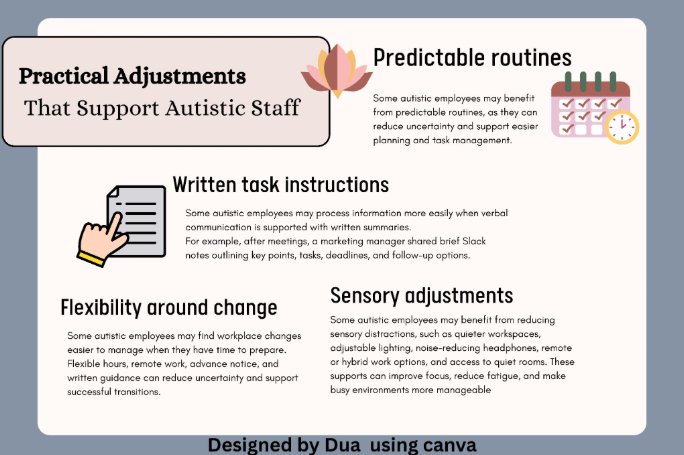
Infographic by Dua, created using Canva.
Many workplace adjustments are inexpensive, easy to implement and beneficial for all employees. Rather than lowering expectations, they remove unnecessary barriers that may prevent autistic employees from demonstrating their abilities.[3][4]
For employers, these adjustments can form part of wider neurodiverse employee support, helping teams move from general awareness into clearer everyday practice.
Predictable routines
Some autistic employees may find predictable routines helpful because they reduce uncertainty and make planning easier.
Example
For example, a software testing team might use a structured daily workflow such as:
- 9:00–9:30 Morning meeting
- 9:30–12:00 Independent testing
- 12:00–1:00 Lunch
- 1:00–3:00 Debugging tasks
- 3:00–3:15 Progress update
Having a consistent structure can reduce interruptions and allow employees to focus more effectively throughout the day.
Written task instructions
Some autistic employees may find written information easier to process alongside verbal communication.
For example, after team meetings, a marketing manager might send brief written summaries through Slack or email that include:
- key discussion points
- task responsibilities
- deadlines
- opportunities to ask follow-up questions
This kind of simple adjustment can reduce misunderstandings, improve task completion and help employees manage competing priorities more confidently.
Sensory adjustments
Some autistic employees may benefit from changes that reduce sensory distractions.
Examples include:
- quieter workspaces
- adjustable lighting where possible
- noise-reducing headphones
- remote or hybrid working
- designated quiet rooms for focused work
These adjustments can improve concentration, reduce fatigue and make busy office environments more manageable.[3][6]
Flexibility around change
Changes are easier to manage when employees have time to prepare.
In practice, this might include:
- allowing earlier working hours, where possible
- offering optional remote working days
- giving notice before schedule changes
- sharing written guidance before introducing new procedures
- holding a short Q&A session to answer questions
These adjustments can reduce uncertainty and help employees adapt more confidently.
The Role of Managers in Retaining Autistic Talent
Managers play an important role in creating workplaces where autistic employees feel supported and valued. Small changes in communication and consistency can have a significant impact on employee confidence and retention.
The importance of consistency
Some autistic employees may find consistent expectations and predictable feedback easier to navigate than constantly changing management styles.
For example, managers can:
- use the same reporting format each week
- provide regular feedback at agreed times
- communicate changes well in advance
- explain expectations clearly
This consistency reduces uncertainty and helps employees focus on delivering high-quality work.
Training and confidence gaps
Managers who have limited knowledge of neurodiversity may feel unsure about discussing workplace adjustments or supporting autistic employees.
Providing neurodiversity training can increase confidence, improve communication and help managers recognise when challenges are related to workplace environments rather than employee capability.[2][3]
For example, after neurodiversity awareness training, a manager may feel more comfortable discussing sensory adjustments, flexible working arrangements or communication preferences with team members. This can support clearer conversations and stronger working relationships.
Small management changes make a big difference
Simple management practices can make everyday work more accessible.
Examples include:
- sending written feedback after meetings
- checking understanding rather than making assumptions
- giving advance notice of changes
- setting realistic priorities
- encouraging employees to discuss adjustments openly
These approaches support clearer communication while benefiting the whole team.
The Cost of Turnover Compared with Workplace Adjustments
Replacing an experienced employee is often considerably more expensive than making practical workplace adjustments. Recruitment, onboarding, lost productivity and training all contribute to turnover costs.[11]
Many workplace adjustments involve little or no financial cost. Flexible communication, predictable routines and supportive management practices can improve retention while helping employees perform at their best.
Retaining experienced employees also preserves organisational knowledge, strengthens client relationships and contributes to a more inclusive workplace culture.
How EI Can Support Workplace Adjustments Across the UK, Canada and International Teams
Workplace adjustment guidance may vary by country, but the practical aim is similar: to remove unnecessary barriers so employees can participate and contribute more effectively.
Exceptional Individuals can support employers in the UK, Canada and international teams with practical neurodiversity training, workplace support and manager guidance. This can help organisations move from general awareness into clearer everyday practice, including communication, meetings, feedback, workload expectations and reasonable adjustment conversations.
In the UK, employers may need to consider reasonable adjustments and workplace guidance from sources such as ACAS and GOV.UK.[3][4][5] In Canada, workplace accommodation guidance also highlights the importance of identifying and reducing disability-related barriers where appropriate.[7][8]
External guidance can help employers understand their responsibilities, but many teams also need practical support to turn guidance into day-to-day workplace changes. EI can help employers build more inclusive systems, strengthen manager confidence and create working environments where autistic and neurodivergent employees can contribute more sustainably.
Conclusion
Practical workplace adjustments are not about lowering expectations. They are about removing unnecessary barriers so autistic employees can contribute their skills, knowledge and perspectives more effectively.
Small changes such as clearer communication, predictable routines, sensory-friendly workspaces and supportive management can improve confidence, reduce turnover and create workplaces where both employees and organisations can thrive.
For employers, the next step is to make workplace support clearer, more accessible and easier to discuss before people reach crisis point.
If your organisation would like support with autism awareness, neurodiversity training, workplace adjustments or manager guidance, Exceptional Individuals can help you identify practical next steps.
EI also offers an Autism in the Workplace Train the Trainer session for organisations that want to build internal confidence and embed more inclusive practice across teams. This can support managers, HR teams, L&D leads and internal facilitators to understand autism, reduce avoidable workplace barriers and apply practical changes in communication, meetings, feedback and adjustments.
Whether your organisation needs a one-off autism awareness session, practical manager training, workplace adjustment support or a Train the Trainer approach, EI can help you move from awareness into everyday workplace action.
Contact Exceptional Individuals to discuss workplace support and training.
Sources and Further Reading
- Harvard Business Review – Neurodiversity as a Competitive Advantage
https://hbr.org/2017/05/neurodiversity-as-a-competitive-advantage - Chartered Institute of Personnel and Development – Neurodiversity at Work Guide
https://www.cipd.org/uk/knowledge/guides/neurodiversity-work/ - ACAS – Adjustments for Neurodiversity
https://www.acas.org.uk/reasonable-adjustments/adjustments-for-neurodiversity - GOV.UK – Reasonable Adjustments for Workers with Disabilities or Health Conditions
https://www.gov.uk/reasonable-adjustments-for-disabled-workers - GOV.UK – Access to Work
https://www.gov.uk/access-to-work - National Autistic Society – What Are Reasonable Adjustments and When Can They Be Requested?
https://www.autism.org.uk/advice-and-guidance/employment/what-are-reasonable-adjustments-and-when-can-they - Canadian Human Rights Commission – Workplace Accommodation Guide
https://www.chrc-ccdp.gc.ca/resources/publications/workplace-accommodation-guide - Employment and Social Development Canada – Opportunities Fund for Persons with Disabilities
https://www.canada.ca/en/employment-social-development/services/funding/opportunities-fund-disability.html - Mental Health Commission of Canada – Workplace Mental Health
https://mentalhealthcommission.ca/workplace/ - Centre for Addiction and Mental Health – Workplace Mental Health Resources
https://www.camh.ca/en/health-info/workplace-mental-health - Society for Human Resource Management – Cost of Employee Turnover Research
https://www.shrm.org/resourcesandtools/hr-topics/talent-acquisition/pages/cost-of-turnover.aspx
Blog Author